Taking Over an Unfamiliar Codebase
How to get a solid grasp of a codebase you've never seen before: understand first, refactor later.
A developer spends most of their working life inside code they didn’t write. You join a new company, inherit a handed-off project, or come back to something you wrote years ago and barely recognize. Writing from scratch is the exception; the real skill is getting up to speed on an existing codebase — quickly and confidently. Over the years I’ve settled into a consistent approach for doing exactly that.
Run it first
The first thing I do is not read the code — it’s run it. I assume I know nothing about the project until I’ve got it running on my local machine.
This step alone is often instructive. Within the first hour you’ll see which setup steps were never documented, which hidden dependencies exist, and how fragile the environment is. The first honest signal about a project’s health is the answer to one question: “How long did it take to get it running?”
Read the tests
Documentation goes stale; comments can lie; but if the tests pass, they tell you what the system actually does. There are few more honest sources for understanding a codebase than its test suite.
Tests give me two things: which behaviors are considered critical enough to protect, and what will warn me when I break something. If there are no tests, that’s information too — I learn upfront that I need to be far more careful when making changes.
Trace one flow end to end
Trying to read all the code at once is overwhelming and inefficient. Instead, I pick a single request and follow it from entry point to database call and back to the response.
That one vertical slice reveals how the codebase thinks — how it separates layers, its naming habits, where decisions are made. Once you truly understand one flow, the second one comes much faster, because now you know the pattern.
Don’t refactor early
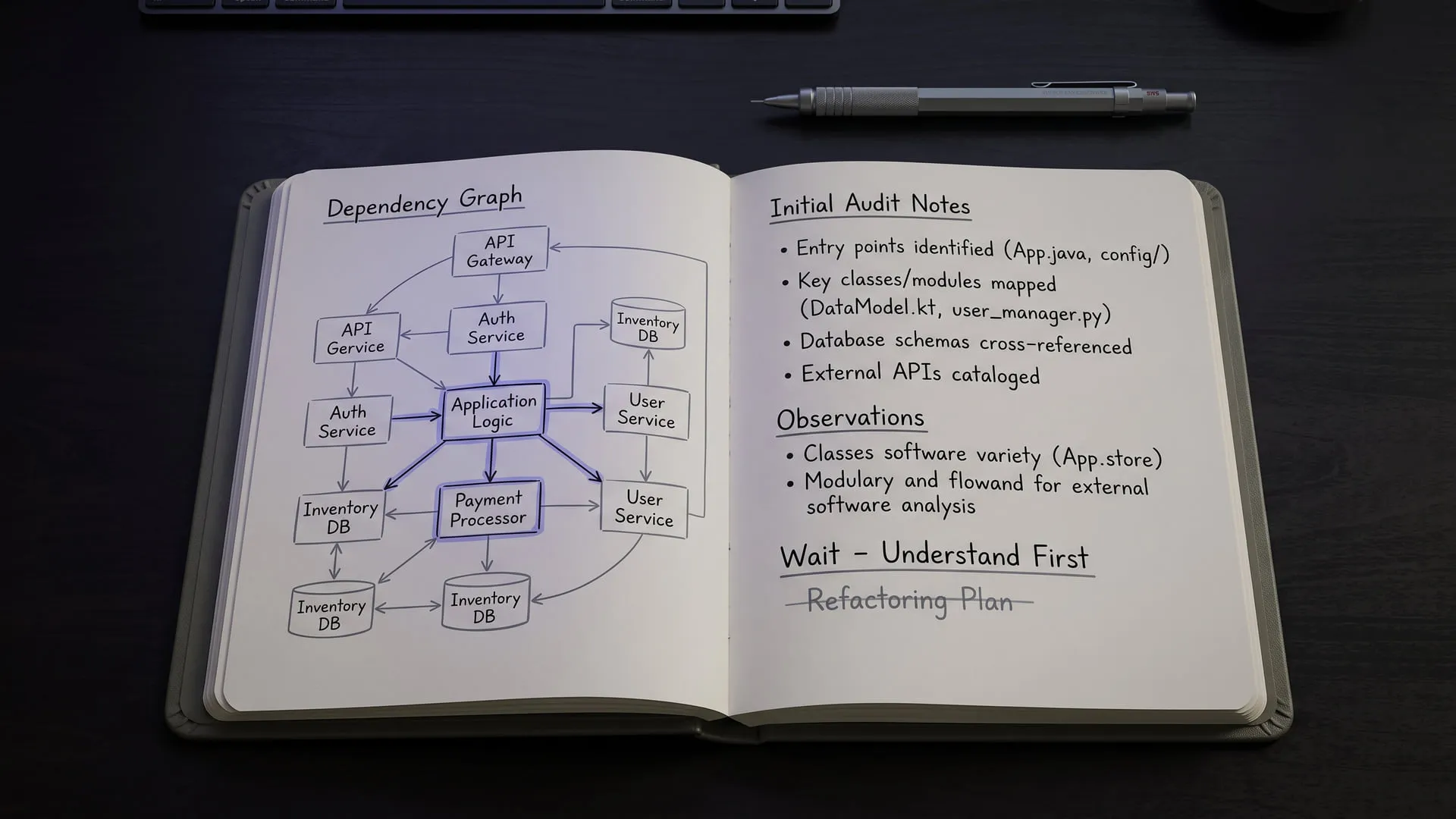
This was my most common mistake as a junior: looking at unfamiliar code, deciding it was “written wrong,” and diving in to fix it. Years have taught me that most code that looks strange carries the fingerprint of a constraint I can’t yet see. That odd if statement probably patched a real bug at some point.
So for the first few weeks I barely refactor at all. I focus on understanding why the code is the way it is. I earn the right to change something only after I’ve also understood why I might not want to.
People and git history are sources too
The code itself isn’t the only source of information. I’ve learned to regularly use two more.
The first is git history. When I run into a line that looks strange, I look at which commit introduced it and what the commit message says. More often than not, a message like “fix such-and-such bug” explains in one sentence why that odd code exists. The code tells you what it does; git history tells you why.
The second is people. If someone has worked on this project before, I collect my questions and bring them all at once — not one by one. A question like “why is this module separate?” can give me in one minute the context that half a day of reading never would. Getting a handle on an unfamiliar codebase isn’t a solo exercise; it also means asking the right questions of the right people.
Summary
Taking over an unfamiliar codebase is not an intelligence test — it’s a patience exercise: run it, read the tests, trace one flow, and don’t touch things early. What looks fast — jumping straight to fixes — is actually the slowest path, because a change made without understanding is usually a change that has to be undone.
Comments
Sign in with your GitHub account to join the discussion. Comments are stored in GitHub Discussions.