Meetings, Reporting and Visibility Theater
The status meeting isn't an information tool — it's an insurance policy. A critique that takes meetings seriously before it takes them apart, seen from three desks.
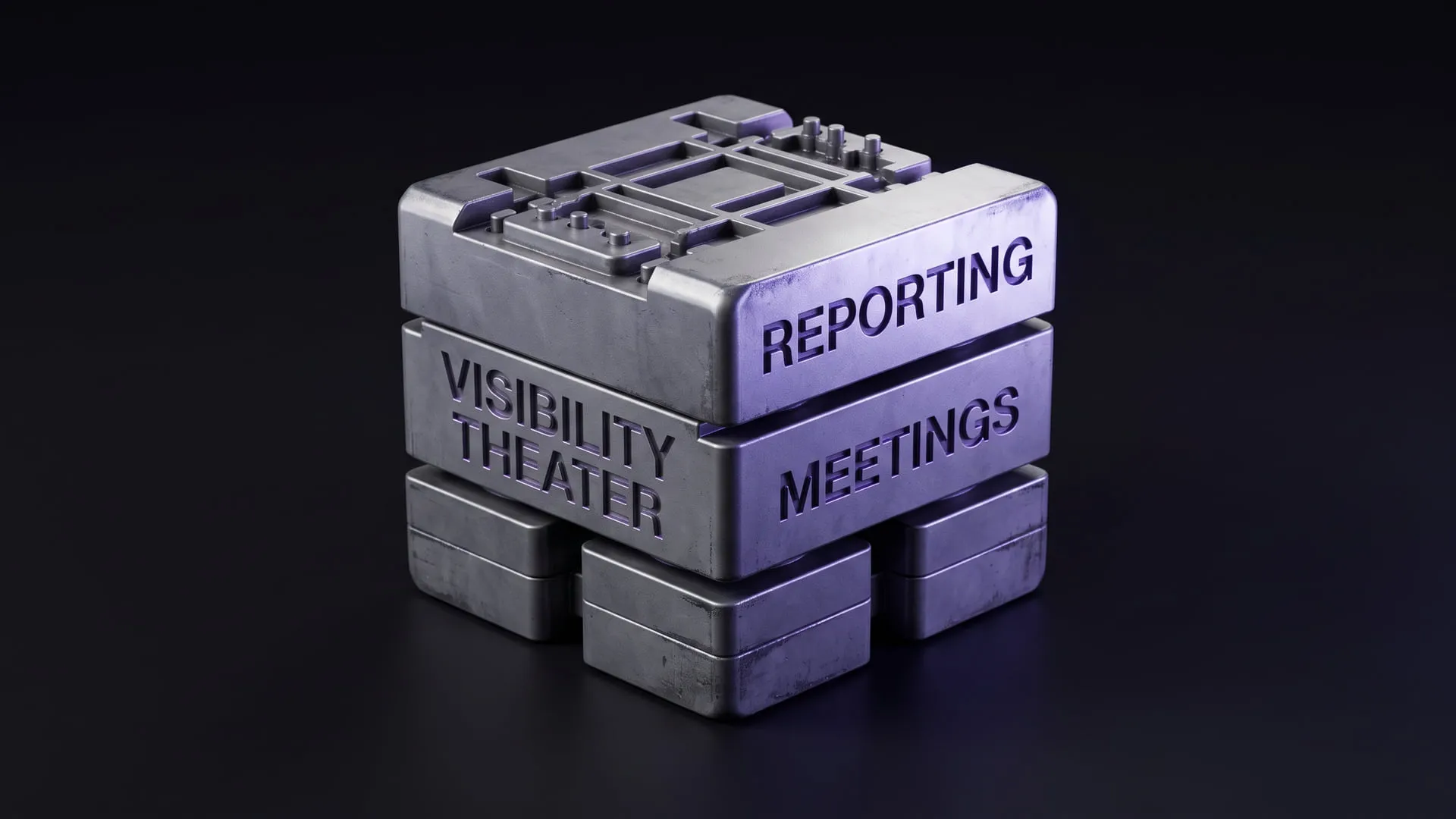
For a while I worked with a team that spent eleven hours a week in meetings. I got curious and went through the calendar slot by slot: eleven hours. Not one of them produced a decision. All of them relayed status — who was doing what, what had slipped, what would “definitely land this week.” The same information, told three times, in three rooms, to three sets of people.
That same year I saw the exact opposite. The calendar was empty; there was no such thing as a meeting culture. But the owner came by your desk an average of four times a day to ask “Where are we at?” No meetings, endless interruption.
At first glance these look like opposites. They aren’t. They are doing the same thing: spending your focus so that someone else can feel calm. This post looks at the most visible expression of the distinction I set up in the first post of this series — because a meeting is where a company’s character walks on stage, every week.
Let me say one thing up front: this is not going to be a “meetings are stupid” piece. That sentence is easy, cheap and wrong. If you want to criticise something, you first have to take seriously why it exists.
In a corporate, the status meeting is risk insurance
Most corporate meetings are not held to move information. It took me a while to see that.
In a large company there is exactly one position nobody wants to be caught in: “I wasn’t told.” When something blows up, the first question is “who knew?” Not knowing looks like innocence in the moment, but that isn’t how a corporate reads it; not knowing means you weren’t standing where you were supposed to be standing. It won’t end your career. It will make you the person who doesn’t get listened to in the next room.
The weekly status meeting exists for precisely this. Its purpose isn’t to transmit information, it’s to put on record that the information was received. Everyone in the room heard it, everyone nodded, and therefore nobody can later say “I had no idea.” That is not an information mechanism. It is a liability-distribution mechanism.
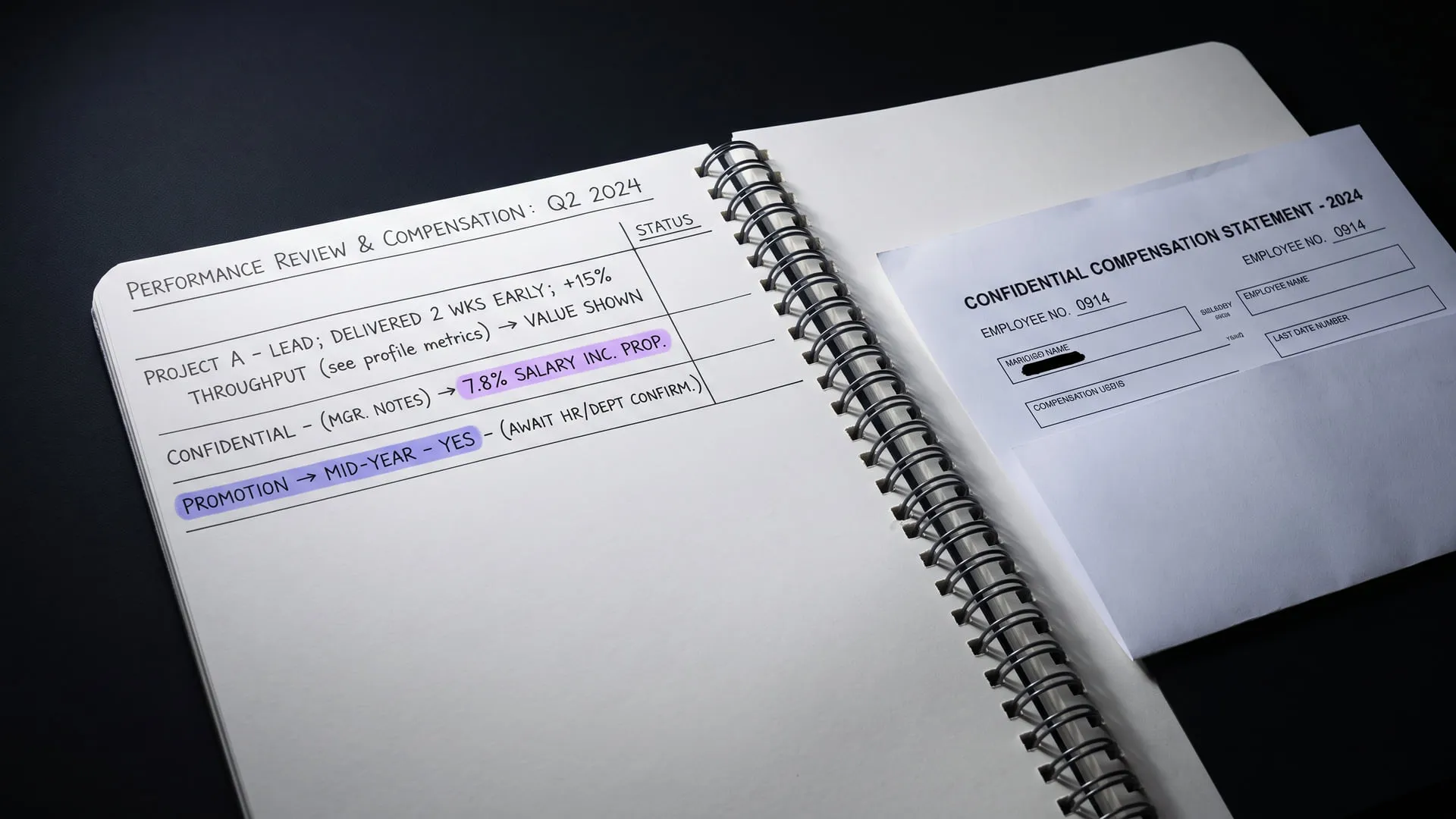
Reports work the same way. That weekly report nobody reads to the end is not a communication tool; it’s a defence document. It doesn’t describe the real state of the work — it proves that the state of the work was described. Two very different things.
The moment you understand this, corporate meetings suddenly start to look rational. And that is exactly why they can’t be removed: nobody cancels their own insurance. When you say “let’s turn this meeting into an email,” what the other person hears is not an efficiency proposal. It’s a loss of cover. The resistance isn’t irrational; it’s managing a different risk than yours.
In an owner-run company, the equivalent is “management by walking by”
In an owner-run company the calendar is clean, and people are proud of it. “We don’t do meetings, we do work.”
The thing they do isn’t called a meeting, but it performs the same function: you stop and explain so that the owner can feel calm. The difference is that it never shows up on a calendar. And because it isn’t visible, its cost isn’t visible either — so everyone assumes it’s free.
But the cost of a question isn’t the length of the question. The cost of a question is how long it takes to rebuild the focus it broke. For a developer in the middle of something complicated, a five-minute question is forty minutes of work; they have to reassemble the whole structure they were holding in their head. Come by four times a day and the day is over. It isn’t that nobody works overtime — everybody is working after seven in the evening, because that’s the first hour the real work can actually start.
The owner usually doesn’t know this, and it isn’t a matter of bad intent. His own job is made of interruptions: phone calls all day, customers, the bank, suppliers. For him an interruption isn’t something that breaks the work, it is the work. It’s genuinely hard to imagine that a thing which costs you nothing costs someone else a great deal.
The result is ironic. The company that considers itself efficient because it has no meetings very often works with less focus than the one that does. A meeting at least has a start time and an end time.
What visibility theater is, and what it isn’t
Don’t read this far and conclude “so visibility is nonsense, I’ll just do my job.” That is the most common mistake I see in this series, and the most expensive.
Visibility is part of the work. The reason is simple and unpleasant: work that isn’t noticed cannot be distinguished from work that wasn’t done. A refactor nobody saw and a refactor that never happened sit on the same line in the company’s ledger. You can experience that as an injustice — it won’t change it. I’ve written elsewhere about why writing and being seen is a career investment; the question here is where that stops.
Theater is the moment visibility takes the place of production. Visibility carries work that has been done; theater, having no work to carry, counts the carrying itself as the work. The line between them is thin, but the test is clear:
Is this meeting producing a decision, or only a record?
A meeting that produces a record could have been a document. Taking an hour from eight people for something that could have been a document is the definition of theater.
A practical distinction: three kinds of meeting
Over the years I’ve landed here: there is no single thing called “a meeting.” There are three separate things, and we use one word for all of them. Most of the confusion comes from that.
| Type | Purpose | What comes out of it | Necessary? |
|---|---|---|---|
| Decision meeting | Make a choice | A decision, and an owner for it | Yes — keep it short |
| Exploration meeting | Understand the problem | A better question | Yes — being messy is normal |
| Status meeting | Report the situation | A record | Usually not — could have been a message |
Separating these three is worth more than cutting the number of meetings. Because the real waste isn’t that the meeting exists — it’s the presence in the room of people who don’t know which meeting they’re in. Someone who walks into an exploration meeting expecting a decision calls it a waste of time. Someone who walks into a decision meeting wanting to explore makes it run long. And someone who walks into a status meeting without knowing why they’re there just waits.
One more thing while I’m here: being included is not the same as being invited. Not every invitation on your calendar belongs to you. Asking “what is my role in this meeting?” isn’t rudeness, it’s professional ethics — and a meeting with no answer to that question is a cost with no answer to that question.
Question: What’s the difference between visibility and visibility theater? Answer: Visibility makes the result of finished work visible. Theater makes busyness visible when there is no finished work. The first carries the work; the second substitutes for it.
Three desks
From the senior engineer’s desk. You have to count visibility as part of the job — even if you dislike it, even if you’d rather say “my work should speak for itself.” But joining the theater and being visible are different things: describing the result of what you did is visibility, describing how busy you are is theater. The first ends in a sentence, the second never ends. Your constraint: you don’t get to decide which meetings you’re called into. The only real authority you hold is working out which kind of meeting you’re sitting in, and behaving accordingly.
From the manager’s desk. You could make the status meeting written and asynchronous. You could do it, your team would thank you, you’d get two hours back. So why don’t you? Because that meeting was never only the team’s channel for being seen by you — it was your channel for being seen upward. Remove it and you gain your team’s focus while losing your own visibility. This is worth admitting out loud: that isn’t laziness, it’s a conflict of interest. And a conflict of interest can’t be resolved until it’s named.
From the owner’s desk. Every “Where are we at?” is free to you; it isn’t free to the team. Your curiosity is legitimate — it’s your money, your risk, and you’re the one who pays for the delay. Nobody gets to argue you out of that. But you’re settling the bill for your curiosity in focus, and that bill never appears anywhere you can see it. Your constraint is real too: in some businesses, finding out once a week is far too late. So the question isn’t whether you ask. It’s when you ask. A question asked four times a day doesn’t bring information back; it only keeps the person preparing the answer from doing the work.
This is the place where all three are right. And all three are paying with the same currency: attention.
Closing
Defending meetings is easy. Cursing them is easy. What’s hard is asking, of each meeting, whose anxiety it’s there to settle.
Ask that and you’ll find that some meetings really are necessary — a decision comes out with an owner attached, a question gets sharper. And you’ll notice that others exist only to manage a worry. You may not be able to abolish the second kind; the worry is real, and managing worry is also work. But you can at least make it cheaper: a document, a message, one written summary a week.
Then you give the time back to the actual work. Which is the only thing worth being visible for anyway.
Comments
Sign in with your GitHub account to join the discussion. Comments are stored in GitHub Discussions.